|
Philip Spiess
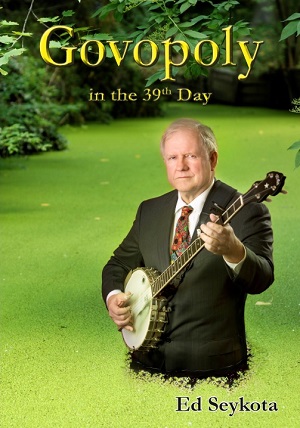
Ed: I love the picture of you playing the banjo; my musical, publicly-performing son stole mine.
Now, I'd like to invoke my status as a cultural historian and comment on the demise of the Ringling Brothers and Barnum & Bailey Circus, known by its slogan as "The Greatest Show on Earth." I had not visited the circus for many years, not since my son (barely in elementary school) was reciting the "Pledge of Allegiance" and shaking President Clinton's hand at the announcement of the funding of the restoration of the "Star-Spangled Banner" at the Smithsonian Institution. But last week, as part of our joint birthday celebration (yes, my son was born on my 45th birthday), he took me and my wife to see one of the last performances of this most famous of circuses. And I think I know why it closed.
But first, a modest amount of history. Phineas T. Barnum first attained prominence as an entertainment promoter in the early years of the 19th Century by touring around an aged black woman whom he said had been "George Washington's nurse" (though aged-looking, she was actually too young to have been such). His real money-maker came, however, with first, his national tour of Jenny Lind, the "Swedish Nightingale" (a popular singer), and then his national tour of "General" Tom Thumb, a midget from England and his midget bride, who were quite a sensation (Tom Thumb was apparently a pretty good performer himself; you can see a period print of his exploits framed on a wall of "The Golden Lamb" Inn in Lebanon, Ohio). These two ventures gave Barnum enough money to open his great extravaganza, the "American Museum" on Broadway, in New York City. It is here he bamboozled and thrilled Americans with the "Fiji Mermaid" (a cobbled-together specimen of taxidermy, combining, in front, a monkey, and, in back, a fish), the mechanical answering machine (a total fraud with a hidden microphone), a true "bearded lady," and many other treats and tricks. It was also here that he supposedly said, "There's a sucker born every minute."
But his great museum in New York burned down, not once, but twice (so did his onion-domed, very Indian-styled palatial home, "Iranistan," in Bridgeport, Connecticut). It was at this point, circa early 1880s, that he got his idea for the circus. Its original motto (superior, I think, to the later Ringling one) was "Alone in All Its Greatness." By this time, Barnum had published numerous editions of his biography, and so, when the circus came to town, Barnum would head up the opening parade around the three rings of the Big Top, riding in a Roman chariot and declaiming to the crowd, "You came to see Barnum -- well, I'm Barnum!" His later association with Bailey was purely transactional; Bailey was the business partner end of the operation. Barnum remained an active entrepreneur to the end; not only did he donate important animals and specimens to major zoos and natural history museums around the United States throughout his career, but he is the clearest and liveliest of all those noted personages recorded by Thomas Edison in the 1890s in the earliest years of the phonograph.
So, my take on the demise of the Ringling (Barnum) Circus: It was once a unique spectacle, but it is no more. Never mind the attacks by animal activists and the like (yes, there was at least one outside on the night we saw the circus); the Feld Entertainment Corporation (owners of the circus since the 1970s) has tried to alleviate that (such as ending the use of elephants last year); and the animals I saw last week (and I was in the second row) looked healthy, well-fed, and happy. No, it was the spectacle itself that had become repetitive and one among many: it reminded me too much of the opening and closing acts of the Olympics, of half-time shows at sports extravaganzas, of rock concerts, and Disney shows, Ice Follies, and the like; it was only the truly "circus" acts that remained unique, that is, the animal acts, the trapeze artists, and the motorcycle riders in the "big ball" (there was, apparently, no more firing of a human being from a cannon, which I'd seen at Cincinnati Gardens and elsewhere) -- the rest was light and sound, signifiying nothing. And thus the circus came to an end. (But you can still visit some of its "greatness" at the Circus World Museum in Baraboo, Wisconsin, the Ringling Circus's summer home -- where I distinguished myself in the early 1970s by being allowed to perform on the steam calliope, and broadcast my mistakes for two miles in every direction! -- or at the John Ringling Estate in Sarasota, Florida -- the circus's winter home, which includes the Ringling estate (Ca d'San), the Circus Museum, and a collection of Renaissance art.)
Epilogue: Just a few more notes on circuses, and then I'll quit. The first elephant in the United States was imported in the 1820s (I believe) into Somers, New York (a bit north of New York City), where you can still see the small, but cute, "Elephant Monument" in the town triangle and the "Elephant Hotel" (no longer operating as such) at one side. The "Barnum Institute" (built by Barnum, I believe), a quaint building, still exists in downtown Bridgeport, Connecticut, and contains (I think; I haven't been in it since I was ten) one of the many "Fiji Mermaids," actually produced in quantity in Japan in the 18th Century. When I was still at Walnut Hills, the Clyde Beatty-Cole Brothers Circus came to Cincinnati and settled somewhere near Lunken Airport on Eastern or Kellogg Avenue ( as I recall), and Jeff Rosen (and maybe Dale Gieringer) and I visited it. Of interest to us were the sideshows consisting of "freaks" (now considered "de trop", but cf. Leslie Fiedler's book, and other recent ones, on "Freaks"), especially "Sealo, the Seal Boy," who had no arms or legs, just hands at the ends of his shoulders and feet at the ends of his hips. Jeff and I spoke with him for some time, and he was a very sympathetic guy. As I recall, we asked him why he chose to show himself off in the circus, and he responded, "Really, what else can I do?" He beautifully signed his name on cards for us with a pen held with his feet (I surely still have the card somewhere). Elsewhere (I think recently) on this site I have spoken of Cincinnati's own John Robinson Circus, which operated circa 1824-1924, and which had its winter quarters in Terrace Park, Ohio. (The Strobridge Lithograph Company of Cinncinnati was the greatest national producer of circus posters during the post-Civil War years and into the 1920s; Cincinnati's Ault & Wiborg Printing Ink Company produced the special vari-colored inks for these posters). My own father, who grew up in Corryville, remembered being hired, as a youth, by some circus (for a pittance) to water and walk its elephants, which were being stored at a barn at the southern edge of the lake in Burnet Woods in Clifton (I believe the "barn" is still there as a park maintenance building).
But enough. I'd be interested to hear if any of the rest of you have reminiscences of the circus.
-- Philip
|