|
Gail Weintraub (Stern)
Here's the article about Mary Benjamin, Arn Bortz, Fred Mayerson, John Osher, Rick Steiner, Julie Waxman (and James Levine, Fred Hersch, Joey Gantz, Steven Spielberg) that appeared in the September 19th edition of the Cincinnati Business Courier. ENJOY!!
It's a lovely Cincinnati neighborhood with stately century-old homes, some you'd call mansions, set behind wide lawns on leafy streets. But North Avondale's Beechwood and Rose Hill avenues are nothing you couldn't find in Hyde Park, Clifton, Mount Lookout or a half-dozen other places in the city. Until, that is, you look closer. And rewind the clock to the 1950s. Because something remarkable was going on.
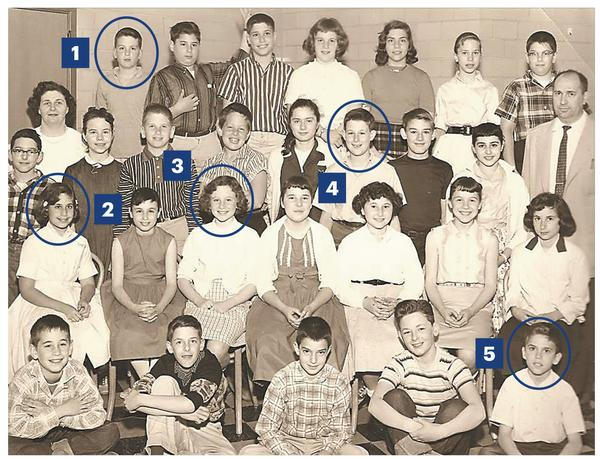
A group that would later be part of the Walnut Hills High School class of 1964 were just little kids, but they would become some of the most successful, high-achieving Cincinnatians in the city's history.
And they all grew up in the same place and were in the same class at North Avondale Elementary School.
Beechwood and Rose Hill lie just west of Reading Road and north of Mitchell Avenue. Wess Park Drive is just on the other side of Clinton Springs.
Those three streets produced a five-time Tony Award-winning Broadway producer, an Oscar-nominated director and producer of documentaries, a former mayor of Cincinnati, the conductor of the Metropolitan Opera in New York, a Los Angeles TV production company executive and an entrepreneur who invented the Spinbrush toothbrush and sold it to Procter & Gamble, not to mention a batch of doctors, lawyers and university professors.
Their achievements put Cincinnati on the national and even international stage, brought plenty of investment dollars to the city and helped craft their high school's reputation as a stepping stone to achievement and success. Indeed, Cincinnati wouldn't be the same city if it weren't for these kids from that class in that neighborhood.
(Oh, and although he moved away from Cincinnati as a young child, there was another Jewish kid born in nearby Avondale in 1946 who you might have heard of: director Steven Spielberg.)
"This class was loaded," said Rick Steiner, the Broadway producer. "I think it was because we were the first of the boomers."
Or maybe there was something in the water. That's the running joke. Many of the group point to the way they grew up to explain their success. Their neighborhood was filled with Jewish families who raised their children to compete and win. Television wasn't dominant. They played outside, together.
"We were all about riding bikes and roller skating," said Mary Benjamin, whose documentary "Eight Minutes to Midnight" was nominated for an Academy Award in 1981. We played "Ghost in the Graveyard."
John Osher, who invented the Spinbrush, loved playing Capture the Flag. Fred Mayerson, who runs an investment firm and built the Chi-Chi's Mexican restaurant chain, played baseball and football and shot baskets at neighbors' houses.
Arn Bortz, Cincinnati's former mayor and a principal with developer Towne Properties, had mud ball fights in the woods behind their houses. "We were just normal kids," he said.
"Our parents didn't know where we were every minute of the day," Benjamin said. "We had a lot of freedom."
People went over to each other's houses so often that Mayerson said he'd consider his friends' parents as his own, and vice versa. There was plenty of intermingling.
"It was more or less like living in a kibbutz," Mayerson said.
Living so closely together also brought out a desire to keep up with one another.
"There was a competitive instinct in us," Bortz said. "When we were in the swimming pool, you'd see other people doing things and you'd think, "I better be able to do that, too."
In other words, a rising tide floats all boats.
"It wasn't in a mean way," Mayerson said. "It was more like, Let's push each other."
Incredible competition.
At that time the neighborhood was heavily Jewish, and their parents came from similar backgrounds with similar values. They were successful themselves, and they emphasized education. (Steiner's father co-owned Kenner Products, which became part of Hasbro; Mayerson's father started a very successful real estate development firm.) The neighborhood was filled with doctors and lawyers, and the kids largely grew up in two-parent homes with strong, stable influences.
"We all had moms and dads who had come out of the Depression," Mayerson said. "They had high expectations for their children."
Benjamin and her three sisters were performers. They wrote skits for birthdays and anniversaries. Their father wrote poems.
"There was a lot of creativity in my family," she said. "It was a healthy and fun childhood."
Osher didn't do well in school, but he was an entrepreneur from age 5. That's when his parents started bringing home nude paintings they'd done in a class at the Cincinnati Art Museum and stored them in the attic. Osher charged friends a nickel to see them.
"That's still my best-margin business," Osher said.
The neighborhood kids all went to North Avondale Elementary. And despite the success so many would achieve, Osher didn't figure anybody thought he or Steiner would go on to fame and fortune. Neither was a great student. But success bred success.
"The competition was incredible," Steiner said.
The teachers at North Avondale Elementary took a strong interest in the kids.
John Bagnoli was a powerful influence on virtually everyone in the class. Steiner said Bagnoli, the sixth-grade teacher at North Avondale Elementary, taught economics and led the class on trips to Washington, D.C. He took the class to his farm and to the restaurant he owned downtown, Osher said.
"He was bigger than life, bigger than Paul Bunyan," Steiner said. "I don't think I ever had a teacher who had a bigger influence."
Another female teacher used to take Benjamin and Julie Waxman out in her convertible during lunch hours when they were in sixth grade. They'd go to Frisch's and drive by Xavier, with the younger girls doing catcalls, Benjamin said.
"Imagine that happening today," she said.
The group all attended Walnut Hills High School, too. Public grade school and public high school. Walnut stressed the humanities, which developed critical thinking, Steiner said.
"It led us to think outside the box."
Still together.
Their achievements were certainly out of the ordinary. Several became doctors, lawyers and university professors and deans. But the success of several in film, theater and music showed this bunch didn't just follow the typical path of going to college and then getting a steady job.
It's also striking how closely knit they still are. Yes, they're far-flung and they don't all stay in touch. But a surprising number of them do.
Benjamin took Waxman to the Oscars in 1981. Two North Avondale kids sitting among Hollywood's biggest stars. When Mayerson puts together business deals, who does he call to invest? Steiner and Osher. Who gave financial backing to Steiner's Broadway productions? Osher and Mayerson. The other two invested in Osher's businesses, too.
It's not limited to the Class of '64. The neighborhood kid who went on to become probably the most famous was a few years older than this group. But James Levine, conductor of the Metropolitan Opera in New York, was close enough in age that they all played together, although Levine often had bigger fish to fry.
People who grew up in the same neighborhood but graduated in the early 1970s include Grammy-nominated jazz pianist Fred Hersch and Joey Gantz, a filmmaker best known for creating the HBO series "Taxicab Confessions" but who also has made serious documentaries, including one about people who lost their homes during the housing crisis.
Quite a group.
Maybe it really was the water.
But it's probably not a coincidence that the bulk of this bunch was born in 1946. It was right after World War II and millions of soldiers came home and started families. The U.S. birthrate jumped 22 percent that year.
Bortz has two older brothers and said he was "an accident in celebration of the war ending." Parents were optimistic about their kids' futures, too, as the world was finally at peace.
Statistics show that the median SAT scores peaked in 1964, the year this class graduated, and then declined steadily until 1980.
Still, none of the group of North Avondale kids said they had any inkling that the class would go on to achieve such special things.
"But looking back, I'd say it was quite a group of talented people," Benjamin said. "It's amazing."
|