|
Philip Spiess
To conclude:
SPRING GROVE III:
AND A FOOTNOTE: THE CEMETERY AND THE RAILWAY
Let’s face it: cemeteries and railroads don’t mix. If a sudden train comes through, it can delay the funeral, block or split the funeral procession up into sections by coming along at the wrong time, or it can make obtrusive noise by blowing its whistle to scatter pedestrians just as the clergyman is saying the last rites. Railroads and cemeteries? A basic no-no.
Well, yes, there was the London Necropolis Railway, 1854 to 1941, which ran from London twenty-three miles southwest to Brookwood in Surrey. Its sole purpose was to carry corpses (in coffins) and mourners (in railway carriages) from central London to Brookwood Cemetery, then (1854) the largest cemetery in the world. Brookwood had been built (as was Spring Grove Cemetery) to alleviate the problem of inner-city, overfilled, overflowing cemeteries, which were helping to spread cholera and the like. In typical English fashion, it had three classes of carriages, 1st Class, 2nd Class, and 3rd Class, as well as two separate loading platforms, one for Anglicans and one for Non-Conformists (and to think that both of these groups were Christian!).
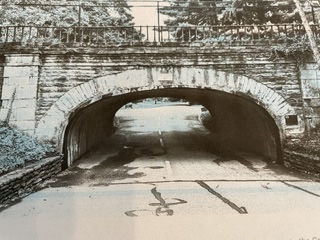
But we are speaking of Spring Grove Cemetery. Anyone who knows the cemetery at all knows that, just as you’ve barely entered the front gates on Spring Grove Avenue and passed the Gothic administration building and the Romanesque chapel, you encounter an ancient railway overpass, picturesque in its own way (partly due to its shape, partly due to its age, and partly due to the shrubbery surrounding it), but which you must go under; it’s like a second gateway, only missing, say, a portcullis, to make it more medieval.
So, what’s a train doing passing through the cemetery? Was it there first? No, it wasn’t. Was it owned by the cemetery proprietors, trustees, or lot holders? No, it wasn’t. It was the Cincinnati, Hamilton & Dayton Railroad (CH&DRR), known by its riders as the “Charge High and Damn Rough Ride.” As a passenger line, it was the main line railroad connecting Cincinnati with Hamilton to the north and beyond. Having just been chartered in 1846, Spring Grove Cemetery was barely three years old in 1849 when the railway planned to build its line through the cemetery grounds.
Why was the railway line doing this? Well, looking at this area along the nascent Spring Grove Avenue at the time, there wasn’t a lot of available land on which to build it heading north. Just to the south of the avenue was the Mill Creek, and just beyond that, at the northern foot of Clifton’s hills, was the Miami & Erie Canal; just to the north of the avenue were the grounds of the cemetery, BUT – the front grounds of the cemetery, now beautiful lakes, were then just swampy marsh lands. Not of much use to the cemetery at the time, this land was leased to local farms to pasture their cows.
The directors of Spring Grove Cemetery took the railroad to court to challenge its plans, but the Ohio Supreme Court, no doubt anxious to increase and improve Ohio’s growing transportation systems in the 1840s, gave the legal victory to the railroad. Still, the railroad did give the cemetery some concessions (no sidetracks, no watering towers, etc.), but it cut off 13 acres at the front of the cemetery; this land was used by workmen. And, of course, the big concession was to let the cemetery build the overpass where the entrance road to the cemetery crossed the rail lines. This overpass, which included raising the railroad tracks on an embankment where they passed through the cemetery property, was originally constructed as a stone arch in the 1850s; the present picturesque overpass was constructed in 1883 in its elliptical form. (There was also something of a station or freight depot just east of Winton Road across from the cemetery in Winton Place. This was not the well-known Winton Place Station – a.k.a. “Chester Park” Station, named after the big amusement park located just across Spring Grove Avenue and to the east of the station – which was at the northern end of Clifton Avenue where it met Spring Grove Avenue; that station is now in the Heritage Village Museum in Sharonville, Ohio.)
The Great Flood of 1913 – the Ohio River, the Great Miami River, and the Mill Creek all flooded downtown Cincinnati and the lower Mill Creek Valley badly, the greatest flood until the Great Flood of 1937 – did significant damage to the Cincinnati, Hamilton & Dayton Railroad, and by 1917 it had pretty much disappeared as an independent line; J. P. Morgan had sold it to the Baltimore & Ohio Railroad.
Nevertheless, trains continued to use the track through Spring Grove Cemetery until the late 1980s. (I remember seeing them go through during Memorial Day Services – see WHHS “Forum” Post #6374, May 29, 2023 – in the 1950s and at later visits to the cemetery in the 1960s.) Sometime during the 1990s the tracks were removed and the railway right-of-way, by this time owned by the CSX Railroad (successor to the B & O), was sold to Spring Grove Cemetery, which now has complete ownership of the land in question. The tracks were completely gone by 1998. All that remains of what was once an intrusive railway in the heart of the peace and tranquility of Spring Grove Cemetery is the elegant railway overpass.
|