Message Forum


go to bottom 
  Post Message
  
    Prior Page
 Page  
Next Page      

04/01/15 09:06 PM #1577    


David Buchholz


What a wonderful stretch!  The first time a first name was on a shirt!

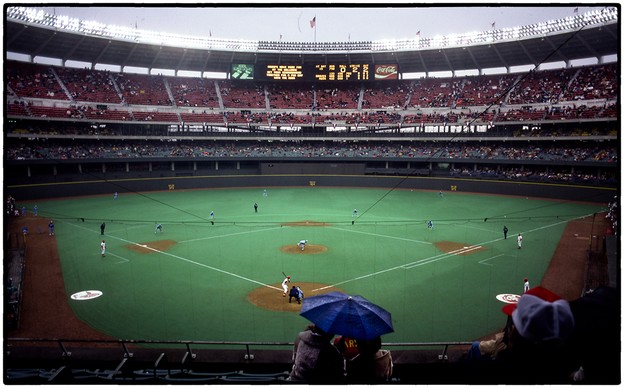
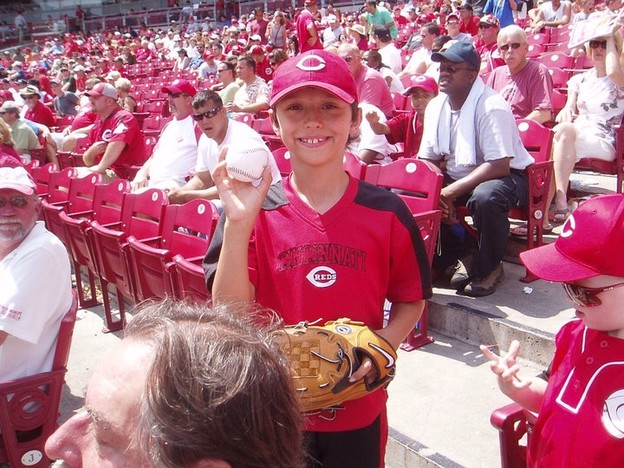
OK, now I'll combine Bruce, Spiess, and Steiner with a quiz.  Here's an Opening Day photograph at Riverfront Stadium.  Who are the Reds' opponents?  What year?

BTW...I gave up going to Opening Day games the year John McSherry died.  R.I.P. John


04/01/15 11:11 PM #1578    


Philip Spiess

Okay, it's April Fool's Day!  I won't do you people in with a rendition of the history of All Fools' Day; you're probably tired of my cultural history verbal dissertations.  Instead, I'll regale you with two of my personal April Fool's memories.  (1)  When I was about 15, on April Fool's Day, my mother rushed into my room (where I was sleeping) and shouted, "Get up!  Get up!  You've overslept and you'll be late for school!"  I jumped up and dashed around like crazy in the bathroom and whatnot -- and then realized it was Saturday!  Although I love my mother, I was not about to forgive her, so I plotted accordingly.  The next year, I got up early and made a sort of effigy of myself in the bed with the pillow and bedclothes.  I then, still being slender in those days, slipped under the bed and waited.  When my mother came in to get me up, I reached out from under the bed and grabbed her ankle -- she nearly hit the roof!  Happy April Fool's Day, mother!  (2) The last year I taught 5th and 6th Grade at Browne Academy in Alexandria, Virginia, I was working somewhat late after school (around 5:00 o'clock), and was coming down the central staircase to go home.  As I reached the bottom step, one of my young students popped out from behind the staircase and yelled "Boo!" then said, "Did I scare you, Mr. Spiess?  April Fool's Day!"  I turned, frowned down the student, and said, "You have a detention!"  The kid turned white and quaking -- before I said, "Did I scare you, Connor?  April Fool's Day!"

Last night Dale Gieringer and I had a memorable reunion dinner in Old Town, Alexandria.  It was as if 50 years had never transpired!

Oh, and Hank:  A further consideration of what's transpiring in the Indiana legislature:  Most people associate the Ku Klux Klan with the Old South -- but the largest membership of the KKK ever was in Indiana in the 1920s. When I was a student at Hanover College in Indiana in the 1960s, I heard the story that there was one county in southern Indiana which, at that time, still had no black residents living in it because a black man was roasted to death on a griddle there (a la Saint Lawrence) in the 1920s (I wouldn't live there either!).


04/02/15 10:14 AM #1579    


Bruce Bittmann

Dave, it's a lousy, rainy day apparently, to make the visitors feel more at home.  SF Giants, who else.  Could be any year given the wet welcome for the visitors, but it was 1975 as the Machine begins it's roll.


04/02/15 01:47 PM #1580    


Ann Shepard (Rueve)

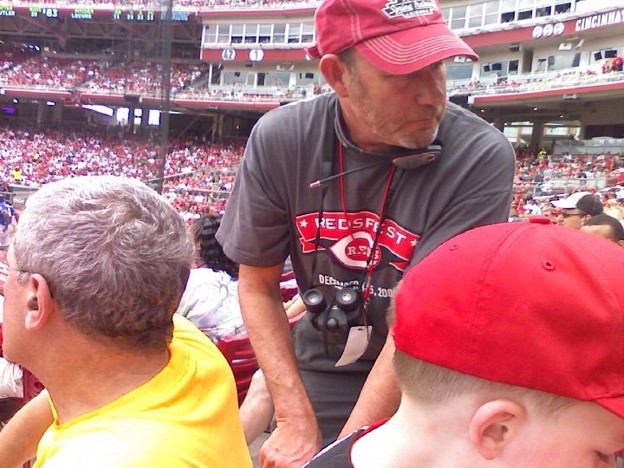
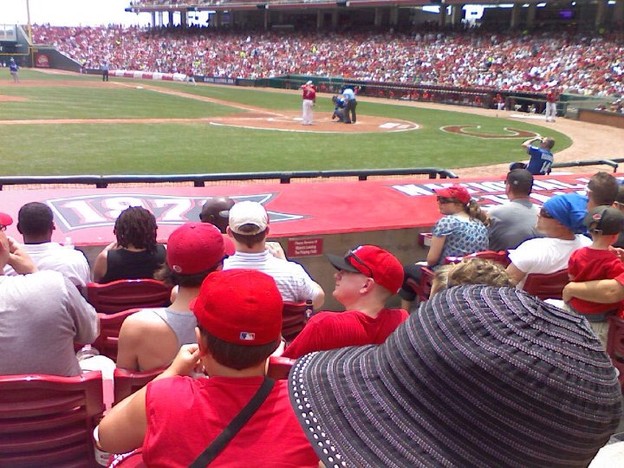
Since the Reds have been brought up, here are a few photos taken from our 2010 outing to Great American Ballpark, hosted by none other than Rick.  It was a wonderful time.  We were delighted when Rick came up to our "ad summum" seats and escorted us to the Diamond seats.  My (now teenage) grandson Griffin was only eight, but a liftetime Reds fan was my date.

Rick, greeting everyone.  Notice the earphones to listen to the WLW radio broadcast of the game on his neck.

Sure wish I could score some seats like this for the All Star game this year.

Rick "assisted" Griffin getting a game ball (still a prized possession).  Steve Kanter (bless his heart) captured the moment.


04/02/15 07:20 PM #1581    


Bruce Fette

OK, Someone needs to find something that Phil Speiss doesnt already know. Anyone have any ideas?


04/02/15 10:18 PM #1582    


David Buchholz

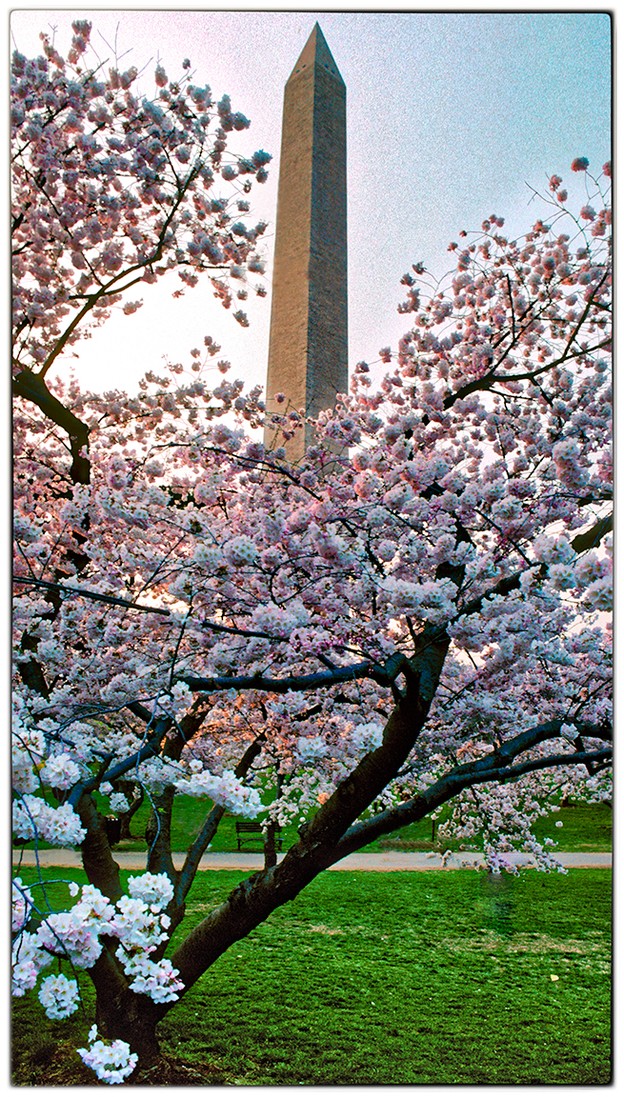
Bruce, we'll work on that.  Meanwhile, since tomorrow is Good Friday I'm posting an Easter photograph I took sometime around 1985 or so...is this how it looks today?  I haven't been back, either at Easter or any other time.


04/02/15 11:32 PM #1583    


Philip Spiess

Bruce, Bruce, Bruce!  I've already given plenty of hints in these pages to what I don't know (baseball, for example, and rockets -- which I came out with you to learn, and hope to learn more of in the future with you).  But what you need to learn is how to spell my last name (how many years have we known each other?) -- "'I' before 'E', except after 'C.'"

Dave:  I'm intrigued by the startling brown color of the Washington Monument in your photo -- it is pretty much white, or, on gray days, rather gray [?].  It was recently swathed in impressive scaffolding to restore it after the Virginia earthquake of several years ago (which hit Washington badly -- Washington's National Cathedral is still being restored as a result), and it is sinking, I think they've said, by almost a foot every twenty years or so.  I have often commented on how the national memorials in Washington reflect those whom they memorialize:  The Jefferson Memorial is a reflection of Jefferson's architectural interests (Roman Revival -- see the Virginia State Capitol, a copy of the Maison Carre in Nimes, France); and the Lincoln Memorial is a tripartite memorial -- the statue by Daniel Chester French represents the man, the building by Henry Bacon represents, as a temple, the martyred president, and (this part most people don't know about) the Arlington Memorial Bridge behind the Memorial reconnects, after the Civil War, the North (Washington) with the South (Virginia).  But the Washington Monument surely is a reflection of "the Father of Our Country" -- it took some 40 years to achieve this erection (which has lasted longer than the four hours after which you're supposed to contact your doctor), and it is the world's largest phallic symbol!

[And I didn't mention, in my notes on Spring Grove Cemetery, that "Fightin' Joe" Hooker, Union general of Civil War fame (who erroneously has had "camp followers," i.e., prostitutes, or "hookers," associated with his name -- the term goes back somewhat earlier), is buried in Spring Grove Cemetery, because his wife was a Cincinnatian.]


04/03/15 01:10 AM #1584    


Larry Klein

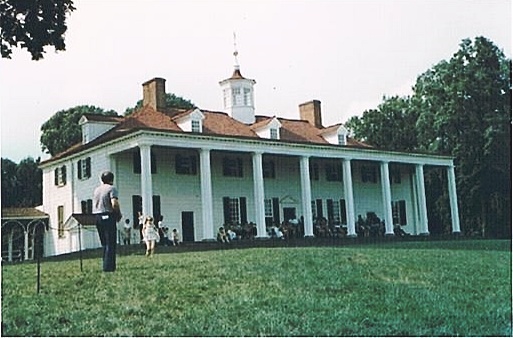
Bruce, Dave and Phil - here's my contribution to Washington monuments.  I'll leave it for Phil to enlighten us on the 'history'.

The photo was taken in 1984.  We took a side-trip from the summer bridge nationals in D.C. on a Potomac riverboat to Mt. Vernon.  That was also the tournament that put me over the top for Life Master with my 300th masterpoint.  I now have 4200 mp's.


04/03/15 10:54 AM #1585    


Philip Spiess

Larry:  That is obviously the experimental prototype for the Howard Johnson's restaurants (their motto:  "We serve 28 flavors of ice cream and 1 flavor of food"); later design corrections improved the look by moving the kitchen indoors, giving the facade an Art Deco styling, and adding an orange roof.  (And I have no idea where it is located.)


04/03/15 11:08 AM #1586    


Chuck Cole

I've been lurking for a while and enjoying very much everyone's postings.  Various posts triggered some nice memories.

I used to go to Mecklenburg's Biergarten with my grandfather in the later 1950s.  One time he took me upstairs where a bunch of older men (when does one become older?) were playing pinochle.  I was intrigued and he taught me to play.  I believe that some of us from WHHS played it at Camp Golden Eagle in the early 1960s, and it was also played quite a bit at Oberlin when I was there.

Lenhardt's was origianlly run by two brothers, who had a major feud and decided they would no longer work together.  One remained at the original location and the other opened a restaurant (I think of the same name).  Menus were similar and my favorite dessert was dobos torte, a multilayered yellow cake with chocoate frosting.  Theirs was good, but nowhere near as good as the one made at the Jewish Bakeshop, which as far as I knew, never made anything that wasn't delicious.  

I found that an excellent way to see plays at the Playhouse in the Park was to be an usher, since you saw the show for free and often people who had series tickets would not show up.  Once the first scene ended and latecomers were seated, we were permitted to take any remaining seat.  I also ushered often at the Cincinnati Symphony (Phill will probably regale us with some history of this glorious building).  My fondest memory of the Symphoney comes from May Festival in 1963, when Issac Stern and Rudolf Serkin teamed up to play Bach's Brandenburg Concerto No. 5.  I'm not sure how a few of us ushers managed, but we were permitted to watch and listen from the wings of the Music Hall stage.  

I'm sure many of us have fond memories of Crosley Field.  We often went to Saturday afternoon games with my mother.  It was ladies day, so she got in for a very low price and children tickets were also quite cheap.  on Saturday's many prime box seats were not taken, partly because people were out playing golf and also because this was when they began to show Saturday afternoon games on TV.  We usually sat right behind the Red's dugout and could put our cups of pop.  [related trivia: It's interesting that Cincinnati sits very near the junction of parts of the US that call all soft drinks pop (midwest and plains states), coke (most of the south), soft drinks (southern Louisiana, most of North Carolina and western Virginia), and soda (northesst and west coast).  

And then there were the Times Theater Saturday matinees, where you could watch a triple feature for 60 cents.  Now it's hard for me to sit through a very long movie, much less three.  Since baseball double headers have evolved (when they happen at all) into separately-ticketed games, sitting through a doubleheader isn't usually an option today.  


04/03/15 01:35 PM #1587    


David Buchholz

No photos this time.  First, Larry has been kind enough to regale me for my photos, Phil for his vast knowledge, and others for their contributions.  But Larry has 4200 masters points!  For those of us who don't play bridge, that's the equivalent of twelve million home runs in MLB.  Many kudos to you, Larry.  And I won't even ask you your handicap in golf.  We can all intimidate each other with something.  You've got at least two.

Phil, you've actually raised an interesting question that the physicists might be able to answer better than I.  The Washington Monument is not that color at all, but the light is actually a bit more red than brown.  You're actually seeing refracted light. Light (I'm really stepping out on a limb here) is made up of red, green, and blue rays, all of which at midday are essentially white.  Because the late afternoon and early morning's rays are redder, it is helpful to know that the red wavelengths  are the longest of the three, and others, such as blue, are scattered and broken up.  When we see a red sky at night this means that the setting sun is sending its light through a high concentration of dust particles.  In the film days we could change the color of light entering the camera with filters; digital photography has led filter makers into new jobs.  And I'm sure, Phil, you could deliver an exposé on light, too.  I just thought it apropos to raise the question here.

There are two remaining Howard Johnson's.  The third one just closed.  I learn oh so much from Facebook.      

And last, Larry.  I have either 1/4 of a Master's Point or 1/2; I can't remember.  In the first hand of the first tournament I entered I was dealt 29 points.  I figured I could make five spades on my hand, so I opened the hand "Six Spades" to the amazement of everyone, (ncluding my wife), who knew that this was our first tournament.  I counted on my partner for one trick.  She was good for it.  No one else bid slam, and we not only had high board, but we waddled successfully through the rest of the evening and won the tournament.  I retired on the spot.


04/03/15 10:54 PM #1588    


Philip Spiess

Chuck Cole:  Thanks for the oral history on Mecklenberg's; I may start to collect these stories, as it turns out to be a significant part of Cincinnati German history, which I don't think has been told before (or, at least, told very well).  (When I was about five or six, my mother took Freddie Zacharias, then my best friend, and his mother to Mecklenberg's for lunch after -- maybe -- the first day of school, say, in Kindergarten.  I got a hamburger, and it was heavily peppered, and I hated pepper in those days, and it was on rye bread, and I hated rye bread, and then my thumb got pinched in the back seat of the car and I cried all the way home.  I avoided Mecklenberg's for years after that!  I'll tell you stories about Freddie Zacharias's father, a noted Cincinnati surgeon and a real curmudgeon, at another time.)

And thanks for the info on Lenhardt's.  I remember when they first opened their restaurant in 1955 on the northwest corner of Clifton and McMillan Streets (or was it the southwest corner?) in a former dry cleaning establishment's premises.  Thereafter they moved east on McMillan Avenue to their long-time location in a handsomely decorated house; I thought that they had closed, but Larry Klein says that they're still open.  I did not know about the feud between the brothers (Kristoff and Antone), who I thought were Austrian, but apparently were from Yugoslavia.  As of 1980, the daughter, Erika, and her husband were still running the restaurant.

I utilized the same scheme you did, Chuck, at the Playhouse in the Park for ushering at the Cincinnati Summer Opera in the Zoo while I was in college.  What glorious days those were:  I spent all day working at historical work I loved in air-conditioned splendor at the Cincinnati Historical Society in Eden Park, then went for a swim at Clifton's swim club, then home for a cocktail and dinner, and, finally, attended outstanding opera at the Zoo (more about that later)!  Chuck:  the "Times" theater -- I remember the name, but don't recall the location (somewhere in western Walnut Hills?).

Dave:  Thanks for the description of the science involved in the lighting of the Washington Monument (I assume late in the day).  I couldn't have said it better, because, although I am, among other things, a historian of science, I am not a scientist.  Your description sounded right to me, but I can add no other data.  (And thanks for the note on Howard Johnson's; I could give you all a history of the franchise -- what we call in historic preservation work "commercial archaeology" -- and which I pushed to national prominence in my days at the National Trust for Historic Preservation -- but I won't . . . for now.)

Finally, Chuck, I return to you:  You've asked (I think) for a history of Cincinnati Music Hall, one of the great architectural glories of Cincinnati, along with Union Terminal, City Hall, the Plum Street Temple, St. Peter-in-Chains Cathedral, and a host of other buildings and homes which I needn't mention now.  I'm well positioned to respond to this, since my Master's thesis in History involved the building, but I'll try to be brief.  Following the Civil War, Cincinnati, which had lost its southern markets during the war, sought to regain them through two schemes, the Cincinnati Southern Railroad (first built to Chattanooga and eventually to New Orleans) -- which would take time to build -- and the Cincinnati Industrial Expositions -- which could advertise at once Cincinnati's commercial and industrial potential and products (my Master's thesis was on the latter).  Prior to the Civil War, Cincinnati had held Mechanics' Exhibitions from 1838 through 1860.  In 1869 a "Great Exhibition" of Textile Fabrics was held in David Sinton's Buildings (Laura Pease, take note).  The success of this exhibition led Alfred T. Goshorn, "father" of the Cincinnati Industrial Expositions (1870-1888), and later the Director-General of the Philadelphia Centennial Exhibition (celebrating the United States' 100th Anniversary, and still later first director of the Cincinnati Art Museum), to direct the Ohio Mechanics' Institute, the Cincinnati Chamber of Commerce, and the Cincinnati Board of Trade to plan a "Grand Exhibition of Arts and  Manufactures" (all of these exhibtions, large and small, were predicated on the "Crystal Palace" Exhibition of 1851 in London, the brainchild of Queen Victoria's consort, Prince Albert).

The long and the short of it is that at the same time, the Nord-Amerikanisches Saengerbund (an international German choral society, with headquarters in Cincinnati) was to meet in Cincinnati, and it erected a large wooden hall for the Saengerfest (this was the origin of the Cincinnati May Music Festivals) west of Elm Street at 14th Street, an auditorium which was later to be turned over to the Industrial Exposition.  Over the several years of the annual Industrial Expositions (1870-1875), the wooden buildings surrounding Saengerfest Hall were added to, extending across Elm Street into Washington Park (Art Hall, for example, had to be disconnected from Mechanics' Hall, in case of fire, and there was also Horticultural Hall, with waterfalls, etc.).

The expositions were discontinued after 1875 for two reasons:  Alfred Goshorn, the director, was now in Philadelphia directing the U. S. Centennial Exhibition (1876), and it had been decided to make Saengerfest Hall and the Exposition Buildings permanent.  Thus our present Cincinnati Music Hall arose (designed by Cincinnati architects Hannaford and Procter), funded in large measure by Reuben Springer (the central auditorium is still officially Springer Hall), and completed in 1879, with the center portion being Music Hall (for Saengerfests and concerts) and the two wings, north and south, being for the Cincinnati Industrial Expositions (on the north, Machinery Hall with belted operations of machines -- Richard Montague, take note -- and on the south Horticultural Hall on the upper floor and Art Hall below).  This is why, if you look, you will see decorations of floral, and art, and mechanical, and music motifs in the brickwork on the two wings of Music Hall (Floral Hall, upstairs in the south wing, later became, in the 1950s, the Topper Ballroom, a night club, first decorated with Egyptian motifs, and later, in the 1960s, with a Hawaiian panorama of Diamond Head).  The continual expansion of these expositions led to additional temporary buildings being added in Washington Park across Elm Street, culminating in the Centennial Exposition of the Ohio Valley and Central States (14th Industrial Exposition) in 1888, with Venetian gondolas on the roofed-over Miami & Erie Canal behind Music Hall (now Central Parkway).

The Great Organ, center stage, by Hook & Hastings of Boston, was (unbelievably) operated by water power from the Miami & Erie Canal behind Music Hall, and was played in free concerts every Sunday afternoon in its early years.  Its magnificent paneled wood carvings, by Fry and Pitman (he of shorthand fame), both of Cincinnati, who led Cincinnati's important school of wood-carving, were a significant part of this organ. Unfortunately, in the late 1890s, the proscenium arch was added to the Music Hall auditorium stage (originally intended for choirs), and it effectively cut off much of the sound from the great organ.  (I remember Robbie Delcamp, in the class behind ours at WHHS, performing Weinberger's "Polka and Fugue" from his opera, Schwanda, der Dudelsackpfeiffer -- Nelson, you know this? -- on the organ with the Cincinnati Symphony Orchestra.)  Somewhere in the early 1970s, the organ was removed to make room on the stage for operatic productions, and its carved wooden panels were hung "artistically" in the orchestra pit.

In the early 1970s, the Cincinnati-based Corbett Foundation, which had been a strong supporter of the internationally famed soprano Beverly Sills, financed the restoration/renovation of Cincinnati Music Hall in order to move the Cincinnati Opera from the Cincinnati Zoo to Music Hall, where it has been ever since.  The Exposition Halls, North and South, were turned into rehearsal halls for music and ballet, scenery storage areas, and reception/dining rooms for supporting patrons of the Symphony, the Opera, and the Ballet, as well as the Trustees meeting room.  I might note that Cincinnati Musicians' Union No. 1, the first professional musicians' union in the United States, began in 1920 by unionizing and starting the Cincinnati Opera at the Cincinnati Zoo (where a German beer garden band played classical music at that time), in order to keep Cincinnati Symphony musicians employed during the summer months.  I believe the Cincinnati Symphony Orchestra played, in the 1920s, at Emery Auditorium, rather than at Music Hall, but the history of the Symphony, and, indeed, the May Festival (which has been discussed much earlier in these pages by me and Ann Shepard Rueve and others) is yet another story.  Cincinnati Music Hall was honored by a U. S. commemorative postage stamp in the late 1970s (at which time I wrote an article on the building for Preservation News, the National Trust for Historic Preservation's monthly newspaper).


04/04/15 09:42 AM #1589    


Bruce Fette

Phil,

Sorry about the spelling. It turns out that I frequently type "receiver" in my day job, and so e most often comes before i as far as my fingers are concerned.

Secondly, Yes I can show you where Washington's house is located. And they do give tours, probably not this weekend however.

Third, my grandfather Fette compiled a book, which I think is called the History of New Alsace Indiana. Ownership of that book now falls to me, and someday I may take the time to republish it. But my point is that it recounts some excellent regional history and German history that you may enjoy reviewing.

And the weather has improved, perhaps you will want to take in another rocket launch.

All DC Locals,

We have agreed to take a skyline tour, we just need to pick a date for doing it. Please send me your recommendations (multiple choices) so I can find common dates for the largest set of folks that can make it.

Larry,

Congratulations on your masterpoints. I am glad someone explained what that means.

Dave,

If you think about a rainbow, water moisture and even the air itself bends the light in such a way that it tends to separate the colors. So as the sun sets, the light rays leading to our geographic area travel through a very long path compared with when they are overhead. (The atmosphere is about 20 miles thick). At sunset the light travels through many hundreds of miles of atmosphere, and the colors separate due to the air density being greater at lower elevation than at high elevation (similar to a glass lens) such that we see the red components. Blue light is scattered by the atmosphere, so the sky looks blue in all directions mid day. But the blue is far more scattered through the much longer atmospheric path at sunset, and just plain doesnt arrive to the local region at sunset.

Still great pictures, even if colors can deceive when the camera makes a contrast between the beautiful white cherry blossoms and the grayish white of the Washington Monument. Yes, they look like that for the next 2 weeks or so.

I think we should have Phil give us all a Segway tour of DC. We would all learn so much.


04/04/15 10:12 AM #1590    


David Buchholz

Bruce, thanks for the explanation.  I expected nothing less.

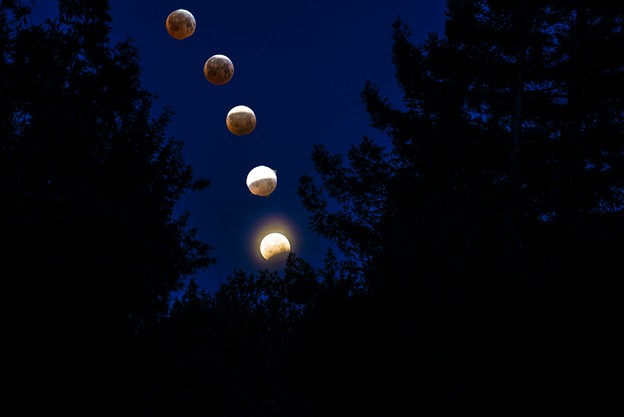
Anyone else up at 4:30?  Sky clear?  Here are five photos blended (poorly) illustrating this moring's lunar eclipse.


04/04/15 04:47 PM #1591    

Rick Steiner

David

in response to your post of April 1, unless this was in keeping with the tenor of the day, I find it difficult to believe it was an  Opening Day photo, as there were no banners visable in the stadium.Judging by the visitors  uniform  I believe the game was against the Montreal Expos who we played  on April 6,1987, and the weather was cold with rain.  There was double barrel action the visitors bullpen. when this photo was taken. .  The  Reds won that day 11-5, and Jeff Perrelt was on the  mound for Montreal  when the Reds were batting  in the bottom of  eighth inning.  .  Hard to tell, but Buddy Bell could have been up.  The game was sold out(as all of our Opening Day games are), but given the score, and the conditions few stayed around til the end. 

Regarding George Foster

He and his wife Vicky camp out in  Goodyear  during most  Reds home spring training  games on the  third base concourse where  he signs autographs and generally brings good cheer to all.  During his caree rwith the Reds he was quite quiet ,but now he has opened up.   He has a wicked sense of humor and is beloved by all. they are often in attendance at Great American Ballpark. 


04/04/15 06:09 PM #1592    


Philip Spiess

Dave:  I didn't see the eclipse -- it was too dark out!


04/04/15 09:08 PM #1593    


Larry Klein

Dave, I hope you had your camera on a timer and didn't stay up all night to get those vabulous photos.

Phil - I suspect you didn't see the eclipse because you were playing with gin rummy... or both?

Reminds me of the slightly tipsy gentleman in Yuma at the train station, inquiring about a ticket to Bakersfield.

"What time does the train leave here for Bakersfield?"

"10pm" was the response.

"And what time does it arrive in Bakersfield"

"10pm" was the response.  "Did you want to buy a ticket?"

"No sir, but I sure want to be here to see that sucker take off."


04/04/15 10:29 PM #1594    


David Buchholz

Rick, on April 9, 1980, the Reds beat the Braves 9-0 (enlarge the scoreboard; it's 9-0 in the bottom of the seventh).  The mean temperature that day was 48 degrees with a high of 55.  .05" rain fell.  As well as my sixty-eight plus year old memory can tell, that was the game, that was the score, that was the weather. and that, as they say, was that.

Frank Pastore, I believe, was the pitcher of record.  More impressive however, was Frank's record in eating the 72 oz. steak called "The Big Texan" in Amarillo, a record he set nine times before losing last year to Joey Chestnut, the competitive eater who always wins the Nathan's Hot Dog eating contest on the fourth of July.

For those of you who are interested in really important stuff, (not that historical crap that Spiess keeps jabbering about), you could look up Pastore's blog on the subject:

http://townhall.com/columnists/frankpastore/2008/03/25/i_held_the_big_texan_steak_record_for_21_years,_until_last_night


04/04/15 11:06 PM #1595    


Philip Spiess

Larry:  Gin and rum don't mix -- but, of course, you can take them in tandem.  (And yours is a new joke to me; reminds me of what I used to tell my students:  "My office hours are from 9:45 to a quarter of ten.")


04/09/15 09:41 PM #1596    


Chuck Cole

Cincinnati Reds and Opening Day--where else but in Cincinnati could a ticket to the opening day game get you excused around noon?  

The Times theater was, I believe on the northeast corner of 6th and Walnut.  At that time, there were three RKO theaters--the Grand, the Palace, and another one whose name I can't remember but I"m sure some of you do.  There was also Keith's on Walnut between 4th and 5th, where all of the Walt Disney movies would come, usually just before Christmas.  My grandmother established a tradition of taking us to the Wheel Cafe for lunch and then to see the newest Disney movie. 


04/10/15 02:52 PM #1597    


Larry Klein

Chuck - that 'other' RKO was probably the Albee, scene of several of my Saturday movie marathons.


04/11/15 01:01 PM #1598    


Ed Seykota

David,

Thank you for stopping your eclipse series in time to prevent the moon from crashing into the trees.


04/11/15 01:46 PM #1599    


Ira Goldberg

I logged on today after a lengthy absence. Appropriately I suppose, just read the posts on Page 64, no less! My question is, how do you guys retain such sharp detailed memories - especially you, Phil - and some really old, albeit historic photographs, at your finger tips? They are fascinating to read and see. 


04/11/15 11:06 PM #1600    


David Buchholz

Ed, thanks for noticing.  I was a little late, and a good part of the moon broke off when it hit the Yearwood's redwood.  We've picked up a lot of the rock and will be packaging and selling it shortly.  You can make a fifteen minute appointment to try on a piece of moon rock and see if you like it before ordering online.

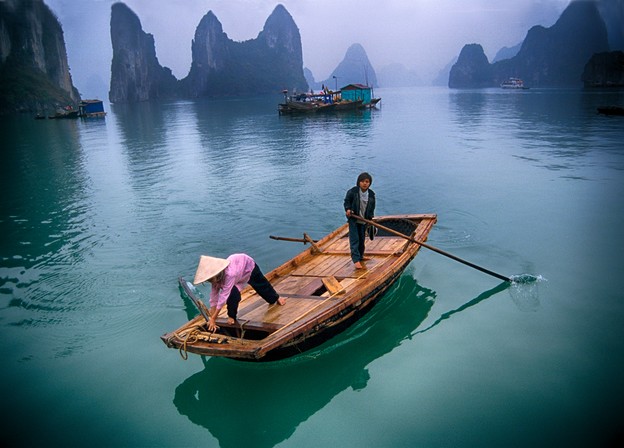
Meanwhile back at the ranch...Ha Long Bay, Viet Nam.  I just like this image:  wonderful colors and tones, and the pink shirt offsets everything else.  The water around the boat is luminous.  You don't see that in the Ohio river, especially at flood stage...


04/16/15 06:10 PM #1601    


David Buchholz

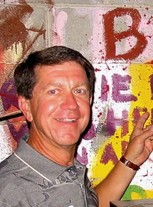
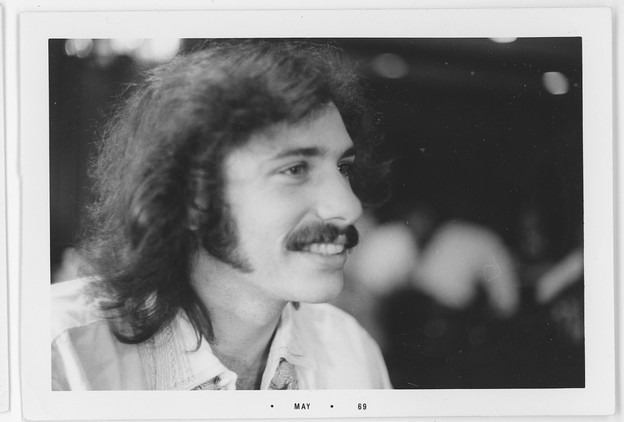
OK, now that no one is looking a the Message Forum, I'm confident I can stuff this photograph in here, and no one will recognize this flower child because no one shows up...


go to top 
  Post Message
  
    Prior Page
 Page  
Next Page